
 English
 Français
 Español
 日本語
 繁体中文
 简体中文


Building an iPhone and iOS Compatibility Test Matrix
Technical Testing & Certification Support | Blue Asia Testing
Contact: Olivia Wang
Email: [email protected]
A product working correctly with one iPhone does not automatically mean it will deliver the same experience across every supported device and software environment.
For connected accessories, automotive interfaces, wireless products, and applications interacting with Apple devices, compatibility testing needs to be planned rather than left to a few isolated checks.
1. Why a Compatibility Matrix Is Useful
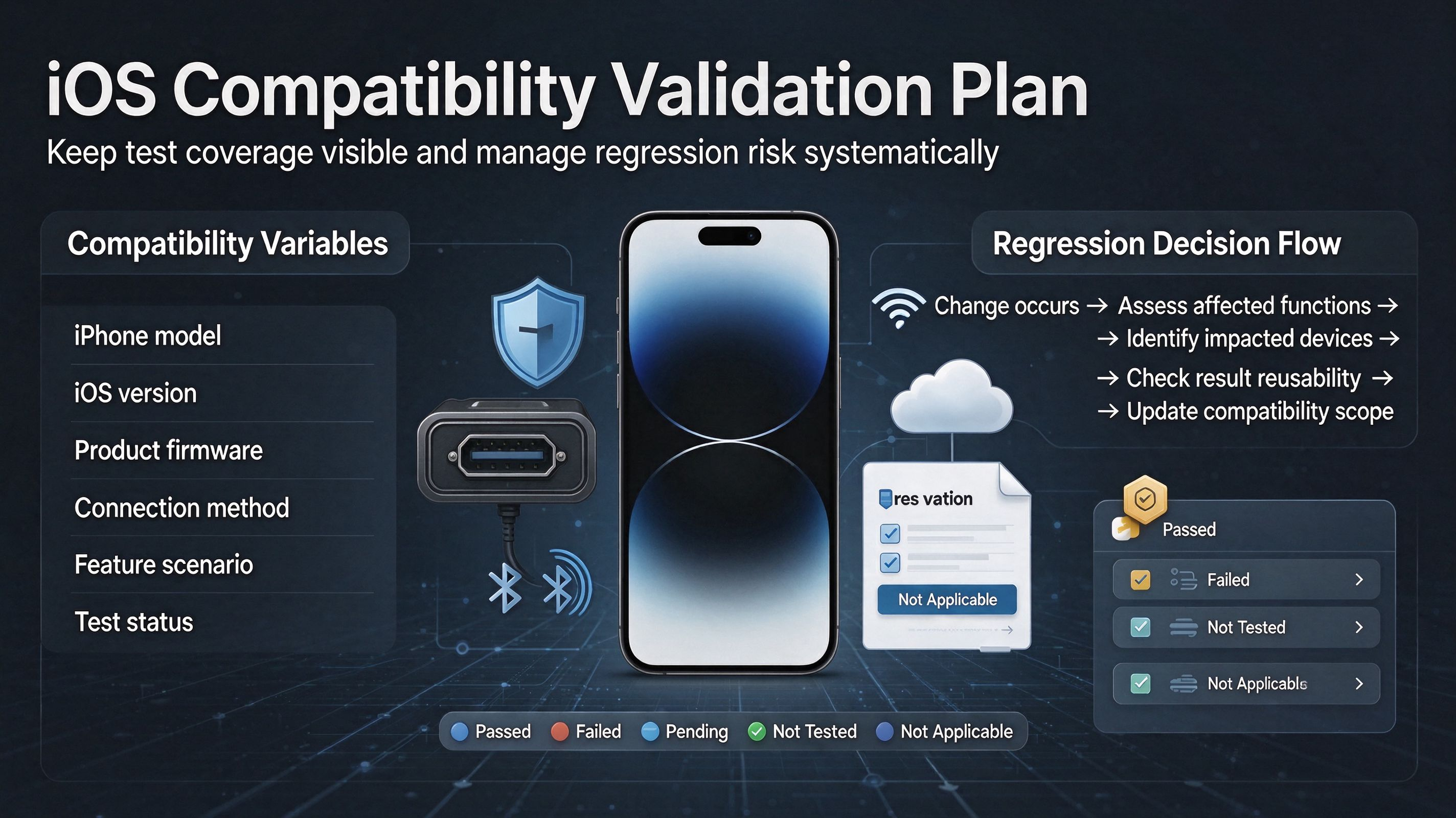
Compatibility issues may be associated with different combinations of:
iPhone models
iOS versions
Hardware configurations
Connection methods
Product firmware or software versions
Supported features and usage scenarios
Testing every possible combination may not be practical. A structured matrix helps teams identify which combinations are important and how testing resources should be allocated.
2. Define the Variables Before Testing
Before building the matrix, establish the product's intended compatibility scope.
| Variable | What to Record |
|---|---|
| iPhone model | Device models selected for validation |
| iOS version | Software versions included in the test scope |
| Product version | Hardware revision, firmware or software build |
| Connection method | Wired, wireless or other supported connection |
| Feature | Function or user scenario being evaluated |
| Test status | Not tested, passed, failed or pending |
| Issue tracking | Defect reference and follow-up action |
The matrix should reflect the product's actual supported configuration rather than an arbitrary list of devices.
3. How to Prioritize Test Combinations
When testing resources are limited, teams can consider a risk-based approach.
Start with the combinations most relevant to the target market, intended users, supported features and known compatibility concerns.
For example:
Validate the primary device and software combinations used during product development.
Include representative device configurations within the declared compatibility scope.
Prioritize combinations associated with critical functions.
Add combinations when specific compatibility risks or customer requirements are identified.
This approach is a project planning recommendation. It does not replace any applicable platform requirements or product-specific validation criteria.
4. Keep the Matrix Updated
Compatibility testing is not necessarily a one-time activity.
When a product firmware, application, hardware revision or supported iOS environment changes, the team should assess whether the existing test results remain relevant.
A controlled regression plan can help answer:
Which functions may be affected by the change?
Which device combinations need to be retested?
Can previous test results still be used?
Are new compatibility issues being introduced?
Does the declared compatibility scope need to be updated?
5. A Practical Test Matrix Example
| Device | iOS Version | Product Version | Feature | Status |
|---|---|---|---|
| Device A | Version X | FW 1.0 | Passed |
| Device B | Version X | FW 1.0 | Pending |
| Device C | Version Y | FW 1.0 | Failed |
| Device A | Version Y | FW 1.1 | Not tested |
This is a sample project tracking format, not an Apple-defined compatibility requirement.
Conclusion
A well-structured compatibility matrix makes testing more transparent, repeatable and easier to maintain.
By defining the supported environment, prioritizing relevant device combinations and tracking regression testing, product teams can improve compatibility management and make better decisions before release.
For connected products and automotive electronic systems, systematic compatibility validation can be an important part of product quality and user experience.
Need support with your testing, certification or market access project?
Blue Asia Testing provides testing and certification support for wireless products, automotive electronics and global market access projects.
Feel free to contact me to discuss your project or testing requirements.
Olivia Wang
Blue Asia Testing
Email: [email protected]
 المدونة
USA: FCC new non-reciprocal economies regulations influencing testing laboratories
اقرأ المقال
 المدونة
Vietnam: MST releases railway mobile communication band plan
اقرأ المقال
المدونة
Vietnam to shut down 2G network completely in September
اقرأ المقال
 المدونة
Automated Vehicle Marker Lamps: New UN Regulatory Developments
اقرأ المقال
 المدونة
Planning Wireless Android Auto Pairing and Wi-Fi Connectivity
اقرأ المقال
 المدونة
Building an iPhone and iOS Compatibility Test Matrix
اقرأ المقال

 4000259520