
 English
 Français
 Español
 日本語
 繁体中文
 简体中文


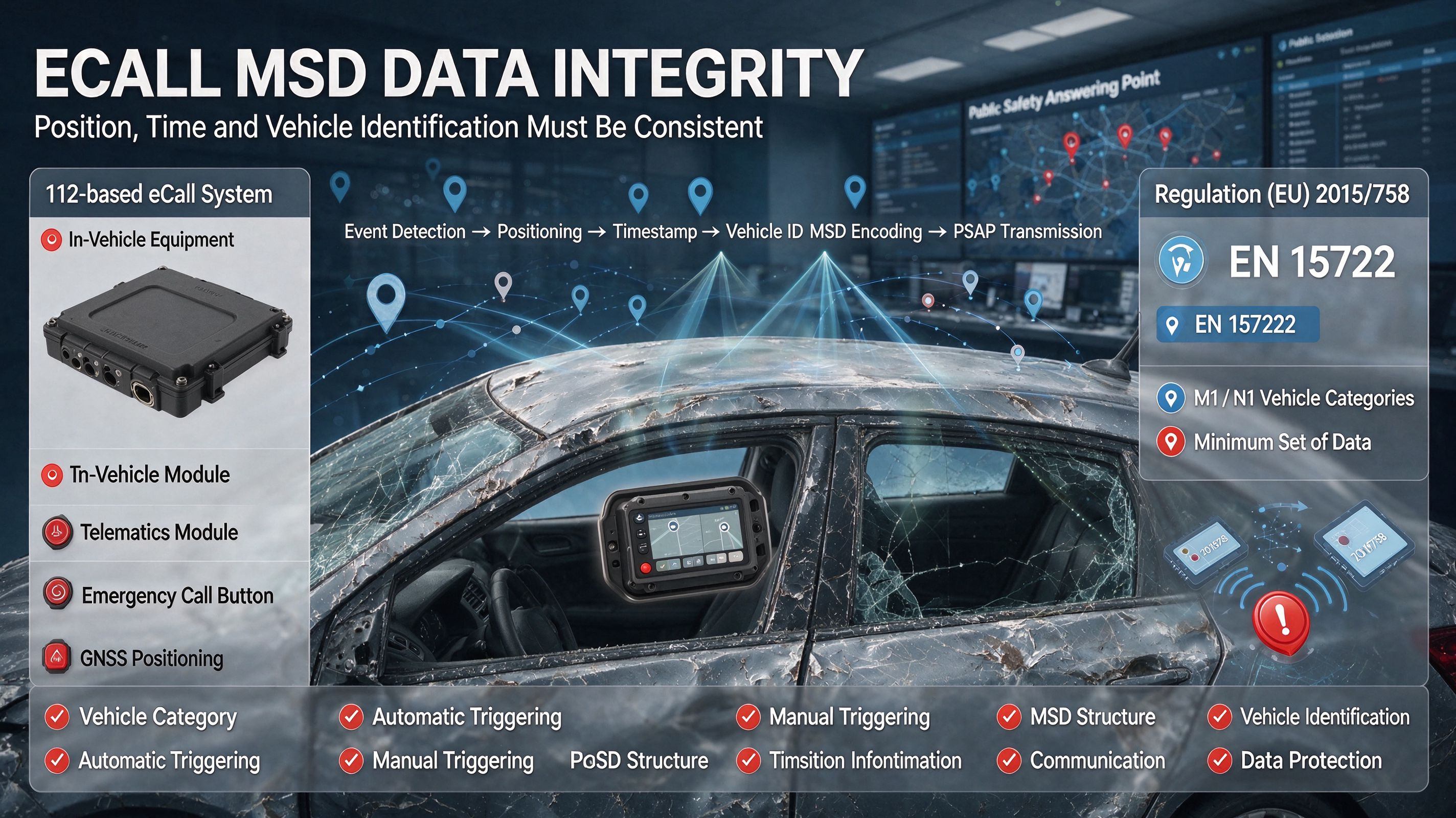
Can Your eCall System Transmit the Right Data? Position, Time and Vehicle Identification Matter.
1. An Emergency Call Is More Than a Voice Connection
When a serious road accident occurs, the ability to establish an emergency call can be critical.
However, an effective emergency communication system involves more than connecting the vehicle to an emergency call centre.
The system also needs to transmit relevant information that can help emergency services understand the situation.
For automotive OEMs, Tier 1 suppliers and telematics developers, this creates an important engineering consideration:
Can the vehicle provide the necessary emergency data accurately and consistently when an eCall is triggered?
This question involves the vehicle's in-vehicle equipment, communication functions, data structure and system integration.
In Europe, Regulation (EU) 2015/758 establishes the regulatory framework for the type-approval requirements relating to the 112-based eCall in-vehicle system.
Understanding the relationship between the regulation and the relevant technical standards is essential for development and compliance planning.
2. Understanding Regulation (EU) 2015/758
Regulation (EU) 2015/758 of the European Parliament and of the Council concerns type-approval requirements for the deployment of the 112-based eCall in-vehicle system.
The regulation applies to vehicles in categories M1 and N1, as defined in the relevant vehicle classification framework, as well as the associated 112-based eCall systems, components and separate technical units designed and constructed for these vehicles.
Certain vehicles are excluded under the conditions specified in Article 2.
The regulation establishes several important obligations.
Automatic emergency call activation
Manufacturers must demonstrate that new vehicle types are designed so that an eCall to the single European emergency number 112 is automatically triggered in the event of a qualifying severe accident detected by the relevant in-vehicle sensors or processors.
Manual activation
The system must also allow an eCall to be triggered manually.
System approval
Manufacturers must ensure that the relevant vehicle systems and associated components are manufactured and approved in accordance with the regulation and its applicable delegated and implementing acts.
These requirements establish the regulatory foundation for the development and approval of 112-based eCall systems.
3. What Is the Minimum Set of Data?
One of the central concepts in eCall is the Minimum Set of Data, commonly referred to as MSD.
Article 3 of Regulation (EU) 2015/758 defines MSD by reference to the relevant eCall minimum-data standard.
The MSD is transmitted to the Public Safety Answering Point, or PSAP.
The purpose of this data is to provide relevant information associated with the emergency call.
For engineering teams, the MSD should not be treated as an arbitrary collection of vehicle information.
Its structure and content need to be aligned with the applicable technical standard.
The regulation also places restrictions on the information transmitted.
Article 6 specifies that the 112-based eCall system must transmit only the minimum information required by the applicable MSD standard.
Additional data must not simply be added to the 112-based eCall MSD transmission.
This distinction is particularly important when a vehicle contains several connected services.
For example, a telematics unit may support emergency communication, remote diagnostics, vehicle tracking and other connected functions.
These functions should not automatically be treated as part of the legally defined 112-based eCall data transmission.
4. Position Information: Why Accuracy Matters
Vehicle position is an important consideration in emergency communication.
When an accident occurs, the location associated with the emergency call can help emergency services identify where assistance may be required.
From an engineering perspective, the position information chain involves more than the presence of a GNSS receiver.
Development teams should consider:
The source of positioning information.
The availability of positioning data.
The relationship between positioning information and the emergency event.
The handling of unavailable or invalid positioning data.
The transfer of relevant information into the MSD structure.
It is also important to distinguish between position information used by the wider telematics platform and the data transmitted as part of the regulated eCall MSD.
The precise required data fields and their encoding must be verified against the applicable version of EN 15722.
A useful engineering question is whether the position data generated by the vehicle can be traced consistently through the entire eCall processing chain.
5. Timestamp Information: Understanding Data Consistency
Time information can be relevant when interpreting emergency event data.
However, engineering teams should not assume that every timestamp generated by a vehicle is automatically part of the regulated MSD.
A vehicle may generate several different time-related records:
The time when an accident-related event is detected.
The time when the emergency call is triggered.
The time when the communication session is established.
The time when the data is transmitted.
The time when the receiving system processes the information.
These timestamps may serve different purposes.
For example, an internal system log may record the time of an event, while a communication log records the time of successful transmission.
The engineering team should identify the purpose of each timestamp and determine which information is required by the applicable MSD specification.
This helps prevent inconsistencies between internal diagnostic records and the data used in the emergency communication process.
The exact timestamp field definition, format and encoding should be checked against the relevant EN 15722 edition rather than inferred from Regulation (EU) 2015/758 alone.
6. Vehicle Identification: Maintaining Data Consistency
Vehicle identification is another important area for system integration.
A vehicle may contain multiple electronic control units, communication modules and diagnostic systems.
These systems may exchange information during normal vehicle operation.
When developing an eCall solution, engineers should consider whether vehicle-related information is handled consistently across the relevant system components.
Important project questions include:
Which vehicle identification information is available to the eCall system?
Which component provides the information?
How is the information transferred to the eCall processing function?
How is data consistency maintained between the vehicle configuration and the transmitted information?
Which technical standard defines the applicable MSD field and encoding?
It is important not to assume that every vehicle identifier stored in a telematics platform is automatically required in the regulated MSD.
The applicable standard must be consulted to confirm the exact data structure.
7. Data Protection Is Also Part of eCall Compliance
An emergency communication system handles information that may be associated with individuals and vehicle movements.
Regulation (EU) 2015/758 therefore includes specific data-protection provisions.
Article 6 addresses several important principles.
Purpose limitation
Personal data processed through the 112-based eCall system must be used for handling the relevant emergency situations.
No constant tracking
Manufacturers must ensure that the system is not traceable and is not subject to constant tracking.
Location retention
The regulation permits retention of the last three vehicle locations in the internal memory, insofar as strictly necessary to specify the current location and direction of travel at the time of the event.
Automatic data removal
The regulation establishes requirements for automatic and continuous removal of data in the internal memory, subject to the specified exception.
No unnecessary additional MSD data
The MSD must contain only the information permitted under the applicable standard.
These provisions should be considered during system architecture and data-flow design.
8. Practical eCall Verification Checklist
The following checklist combines regulatory review and project-management recommendations.
Checkpoint | Why it matters | Recommended action |
|---|---|---|
Vehicle category | Determines the regulatory applicability | Confirm whether the vehicle falls within the scope of Article 2 |
Automatic triggering | Required for qualifying severe accidents | Review the accident-detection and triggering architecture |
Manual triggering | The system must support manual activation | Verify the manual trigger function |
MSD structure | The data must follow the applicable standard | Confirm the applicable EN 15722 edition |
Position information | Relevant to emergency location | Review the source, availability and data-handling chain |
Timestamp information | Helps evaluate data consistency | Confirm the relevant standard-defined field and encoding |
Vehicle identification | Helps maintain consistency across system components | Trace the applicable vehicle data source |
Communication | eCall requires an emergency communication session | Review the relevant communication and end-to-end requirements |
Data protection | Personal data is subject to specific restrictions | Review data storage, deletion and access controls |
Documentation | Manufacturers need evidence of system conformity | Maintain traceable design and validation records |
9. What Has Not Automatically Changed?
Several conclusions should be avoided when interpreting Regulation (EU) 2015/758.
First, the regulation does not mean that all telematics data must be included in the eCall MSD.
The MSD is limited by the applicable standard and the data-protection provisions.
Second, a successful GNSS position calculation does not automatically demonstrate complete eCall conformity.
The entire data-processing and communication chain must be considered.
Third, internal vehicle timestamps should not automatically be treated as mandatory MSD fields.
The exact fields must be confirmed against the applicable standard.
Fourth, the existence of a connected vehicle platform does not eliminate the need to distinguish emergency communication from other telematics services.
The regulatory requirements for the 112-based eCall system must be evaluated separately.
10. Conclusion
eCall development requires coordination between vehicle electronics, positioning functions, communication modules, data processing and regulatory compliance.
For automotive OEMs and Tier 1 suppliers, the most useful starting point is to identify the applicable regulatory obligations and the technical standards that define the required data structure and system behaviour.
A structured verification approach can help identify data inconsistencies and integration issues before the final approval stage.
Blue Asia supports electronic product manufacturers with testing and global market-access-related services, including EMC, RF and wireless testing.
For automotive communication and telematics projects, the applicable test scope should be assessed according to the system architecture, relevant technical standards and target markets.
Contact Blue Asia
Email: [email protected]
WhatsApp: +86 17663606879
 المدونة
Does Your DAB+ Receiver Know When to Retune? Cross-Region Driving Can Expose Hidden Design I
اقرأ المقال
 المدونة
Are You Testing Android Auto Too Late? The Desktop Head Unit Can Help Move Validation Earlie
اقرأ المقال
 المدونة
Can Your eCall System Transmit the Right Data? Position, Time and Vehicle Identification Mat
اقرأ المقال
 المدونة
Does Your CarPlay Interface Really Fit the Vehicle? Display and Interaction Need More Than B
اقرأ المقال
 المدونة
Why The Best Compliance Strategy Is To Design Products That Never Need Retesting
اقرأ المقال
 المدونة
Why Automotive Connectivity Certification Is No Longer About One Test—It's About Buildi
اقرأ المقال

 4000259520