
 English
 Français
 Español
 日本語
 繁体中文
 简体中文

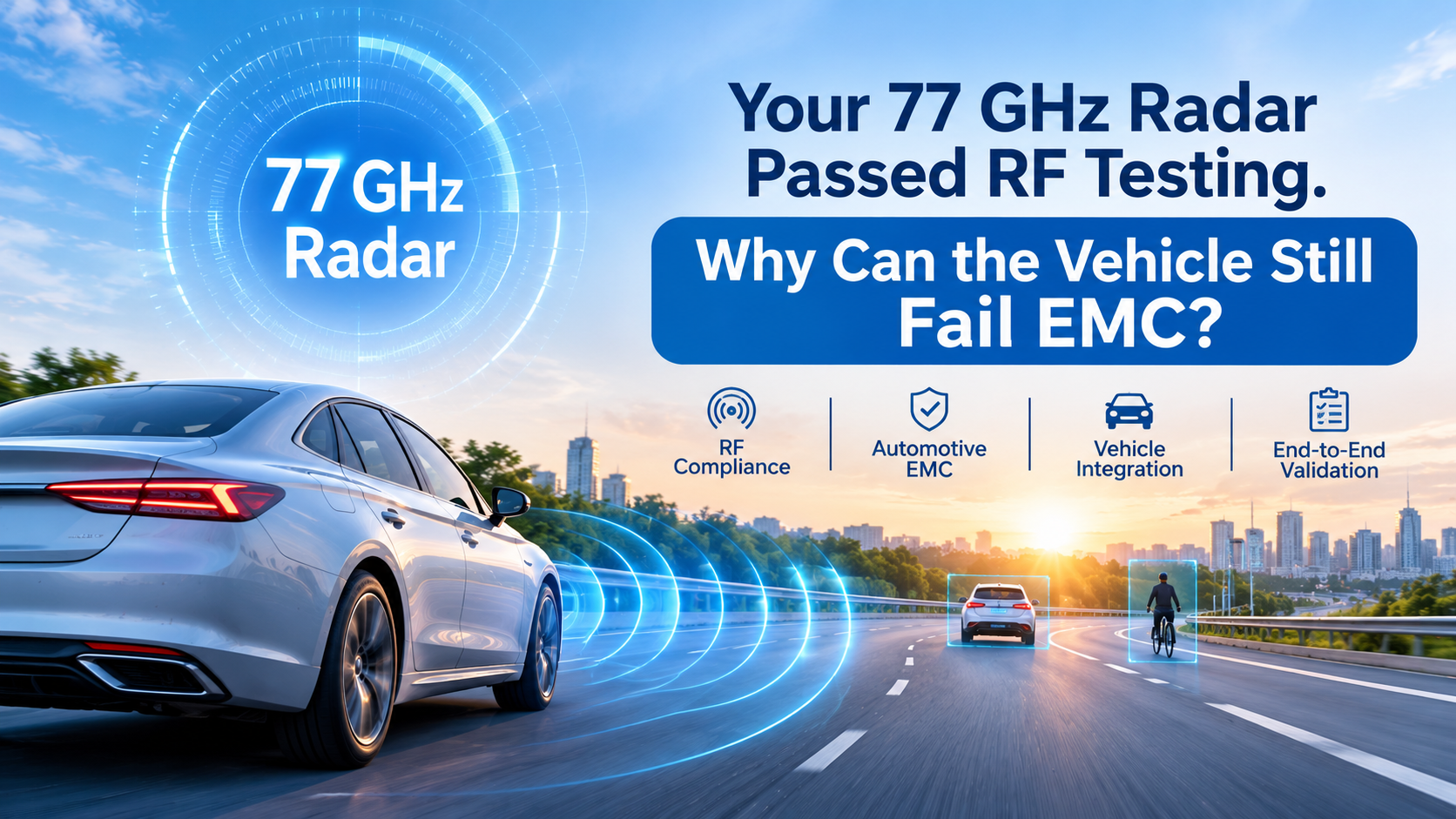
Your 77 GHz Radar Passed RF Testing. Why Can the Vehicle Still Fail EMC?
Your 77 GHz Radar Passed RF Testing. Why Can the Vehicle Still Fail EMC?
Your 77 GHz radar passed the RF test.
The frequency is correct.
The output power is within limits.
The radio test report is complete.
Then the OEM asks:
“Where is your automotive EMC validation?”
And the engineering team starts wondering:
If the radar already passed RF testing, what exactly are we testing again?
This is one of the most common misunderstandings in automotive radar compliance.
For ADAS, Blind Spot Detection, Parking Assist, Adaptive Cruise Control and AEB, the radar is not simply a 77 GHz radio.
It is a sensor installed inside a complex electromagnetic environment.
That changes the compliance question.
Radar Compliance Has More Than One Layer
A typical automotive radar compliance path looks more like this:
77 GHz RF
↓
Radio / Spectrum Compliance
↓
Radar Sensor Hardware
↓
Antenna / Radome
↓
Vehicle Installation
↓
Automotive EMC
↓
UN R10 / OEM Requirements
↓
Real Vehicle Environment
The first layer asks:
Does the radar use the radio spectrum correctly?
The later layers ask:
Does the radar continue to operate correctly when installed in a real vehicle surrounded by other electronic systems?
Those are different engineering questions.
For example, ETSI standards cover automotive radar in the 76–77 GHz and 77–81 GHz ranges, including applications such as obstacle detection, blind spot detection, parking aid and pre-crash systems.
But passing the applicable radar radio test does not by itself prove vehicle-level EMC compatibility.
1. RF Compliance Does Not Mean Vehicle EMC Compliance
This distinction is critical.
Radar RF Testing may examine parameters such as:
Operating frequency
Transmit power / EIRP
Occupied bandwidth
Emissions
Spectrum usage
Receiver characteristics
Radio performance
Automotive EMC Validation asks different questions:
Can the radar tolerate electromagnetic disturbances?
Can other vehicle electronics interfere with the radar?
Can the radar create unacceptable disturbances to other vehicle receivers?
Does the sensor remain stable during electrical transients?
Does the installed harness create additional coupling?
Does the complete vehicle configuration meet the applicable OEM or type-approval requirements?
CISPR 25 is specifically aimed at radio disturbances and protection of receivers used on board vehicles. IEC notes that mounting location, vehicle body construction and harness design can affect coupling, which is why component and vehicle-level considerations cannot simply be treated as interchangeable.
2. Why Can a Radar Pass the Lab and Fail the Vehicle?
The most common reason is simple:
The laboratory configuration is not the vehicle configuration.
A radar sensor installed on a bench may have:
Short cables
Controlled grounding
Stable power
No nearby high-power electronics
No production harness
No vehicle body
No adjacent radar sensors
The production vehicle may have:
Multiple radar sensors
Cameras
LiDAR
ADAS ECUs
DC/DC converters
Inverters
Ethernet
CAN/CAN FD
Infotainment
Cellular modules
Wi-Fi / Bluetooth
GNSS
High-current motors
Long vehicle harnesses
The electromagnetic environment is completely different.
3. Radar Antenna and Radome Are Part of the System
Another common mistake is treating the radar module as an isolated box.
The actual RF path is closer to:
Radar IC → RF Front End → Antenna → Radome → Bumper → Vehicle Environment → Target
Changing any of these can affect performance.
For example:
Antenna position
can change field of view and detection coverage.
Radome material
can affect RF transmission and attenuation.
Bumper material
can influence radar propagation.
Installation angle
can change the detection zone.
Vehicle structure
can create reflections and multipath effects.
So a radar that performs correctly during component testing can behave differently after integration.
4. Radar-to-Radar Interference Is Becoming More Important
Modern vehicles may have several radar sensors operating simultaneously.
For example:
Front radar
Corner radar
Rear radar
Blind-spot radar
Now consider two vehicles passing each other, multiple radar sensors operating simultaneously, and other RF systems operating around them.
The question becomes:
Can the radar maintain reliable detection when other radar systems are transmitting nearby?
This is not simply a certification question.
It is a sensor coexistence and system-performance question.
Possible symptoms include:
False detection
Missed detection
Reduced detection range
Unstable target tracking
Increased noise floor
Unexpected sensor warnings
Temporary loss of radar function
This is why radar validation should consider the operating environment, not only the transmitter itself.
Radar EMC Failure Investigation Matrix
When a radar system fails during vehicle validation, do not immediately assume the radar RF design is defective.
Use a structured failure investigation.
| Failure Symptom | Possible Cause | First Area to Investigate |
|---|---|---|
| False Detection | RF interference / multipath | Radar environment |
| Reduced Detection Range | Antenna / radome / installation | RF path |
| Sensor Reset | Power disturbance / EMC | Power + EMC |
| Communication Loss | CAN / Ethernet interference | Harness + communication |
| Unstable Tracking | Radar coexistence | Sensor-to-sensor interference |
| Unexpected Warning | EMC disturbance / software reaction | EMC + software logs |
| Vehicle EMC Failure | Harness / grounding / coupling | Vehicle installation |
| Good Bench Result, Poor Vehicle Result | Integration environment | Installation configuration |
The objective is not simply to ask:
“Did the radar fail EMC?”
Ask:
“At which layer did the failure first appear?”
5. Component EMC and Vehicle EMC Are Not the Same Test
This is where project teams often lose time.
For an automotive radar project, you may have several validation layers:
Layer 1 — Radio Compliance
77 GHz RF / applicable regional radio requirements
↓
Layer 2 — Component EMC
CISPR 25 / ISO 11452 / applicable OEM requirements
↓
Layer 3 — Electrical Environment
Power transients / grounding / supply disturbances
↓
Layer 4 — Vehicle EMC
Vehicle-level emissions and immunity
↓
Layer 5 — Functional Performance
Detection / tracking / warning / ADAS function
↓
Layer 6 — Type Approval / OEM Validation
UN R10 and OEM-specific requirements where applicable
UN R10's EMC framework includes separate vehicle and ESA/component testing, including CISPR 25-related emissions and ISO 11452-based immunity methods for applicable configurations.
So when an OEM asks for additional validation after your RF report is complete, it does not necessarily mean they are asking you to repeat the same RF test.
They may be asking a completely different question:
“Can this sensor work reliably inside our vehicle?”
6. What Should Radar Manufacturers Validate Before SOP?
For a new 77 GHz automotive radar, I recommend establishing a configuration baseline before formal testing:
Radar Chipset
→ RF Front End
→ Antenna
→ Radome
→ Firmware
→ CAN / Ethernet
→ Power Supply
→ Harness
→ Vehicle Mounting Position
→ Adjacent Sensors
→ Vehicle Configuration
→ EMC Evidence
→ RF Evidence
→ Functional Validation
This becomes particularly important when engineering changes occur.
For example:
Radar chipset change
RF front-end change
Antenna change
Radome material change
Bumper change
Mounting-location change
Firmware update
Power-supply change
CAN/Ethernet architecture change
Sensor quantity change
A small hardware or software change should trigger an impact assessment against the existing RF, EMC and functional evidence—not an automatic assumption that everything must be retested, and not an assumption that the old evidence remains sufficient.
The Question I Would Ask Before Starting Radar Testing
If I were reviewing a new radar project with an automotive OEM or Tier 1 supplier, I would not start with:
“Which 77 GHz RF test do we need?”
I would start with five questions:
1. What radar frequency and operating mode are being used?
2. Is the radar being tested as a standalone ESA or as part of a vehicle system?
3. Where will the radar be installed, and what is around the antenna?
4. Which EMC requirements come from UN R10, the OEM and the vehicle platform?
5. What functional failure would occur if the radar experiences an RF or EMC disturbance?
These five questions can determine the test strategy before the first sample enters the chamber.
Where BlueAsia Can Help
At BlueAsia, our advantage is not limited to a single 77 GHz RF test report.
We can connect the different engineering layers:
RF Testing
Automotive EMC
EMC Troubleshooting
Antenna / RF Path Review
Automotive Electronics
Bluetooth / Wi-Fi / Cellular Coexistence
Vehicle-Level Pre-Validation
Compliance Evidence Review
This is particularly relevant for:
Automotive radar manufacturers
ADAS suppliers
Blind Spot Detection suppliers
Parking Assist systems
AEB suppliers
Tier 1 automotive electronics companies
Vehicle OEM engineering teams
Radar sensor and ECU manufacturers
Connected vehicle electronics suppliers
Our goal is to identify whether a failure is actually coming from RF, EMC, power, harness, antenna, installation, coexistence or vehicle integration before the project reaches the final certification stage.
Final Thought
A radar can be radio-compliant and still be vehicle-incompatible.
That is the key distinction.
For automotive radar, the compliance chain is not:
77 GHz Test → Pass → Done
It is closer to:
RF Compliance → Component EMC → Vehicle Integration → EMC Validation → Functional Performance → Type Approval / OEM Validation
The radar sensor is only one part of the electromagnetic environment.
If your 77 GHz radar has passed RF testing but your OEM is asking for additional EMC or vehicle-level validation, the right response is not “Why do we need another test?”
The better question is:
“What new risk is this test designed to prove—or eliminate?”
If you are developing a 77 GHz radar, ADAS sensor, Blind Spot Detection system, Parking Assist or AEB-related automotive electronics, BlueAsia can help map the RF, EMC and vehicle-validation requirements before formal testing.
Talk to BlueAsia Labs about your radar compliance and EMC validation plan.
 المدونة
Why Buses And Trucks Face Different Connectivity Challenges Than Passenger Cars
اقرأ المقال
 المدونة
The Future Compliance Engineer Will Need to Understand Systems—Not Standards
اقرأ المقال
 المدونة
Trucks and Buses Exported to the Middle East: Do eCall and DAB+ Apply the Same Way?
اقرأ المقال
 المدونة
Your 77 GHz Radar Passed RF Testing. Why Can the Vehicle Still Fail EMC?
اقرأ المقال
 المدونة
Does CE RED Replace EMC Testing? Understanding the Relationship Between Radio and EMC Requir
اقرأ المقال
 المدونة
Does eCall Work Only After a Crash? Understanding Automatic and Manual Trigger Testing
اقرأ المقال

 4000259520