
 English
 Français
 Español
 日本語
 繁体中文
 简体中文


Trucks and Buses Exported to the Middle East: Do eCall and DAB+ Apply the Same Way?
Trucks and Buses Exported to the Middle East: Do eCall and DAB+ Apply the Same Way?
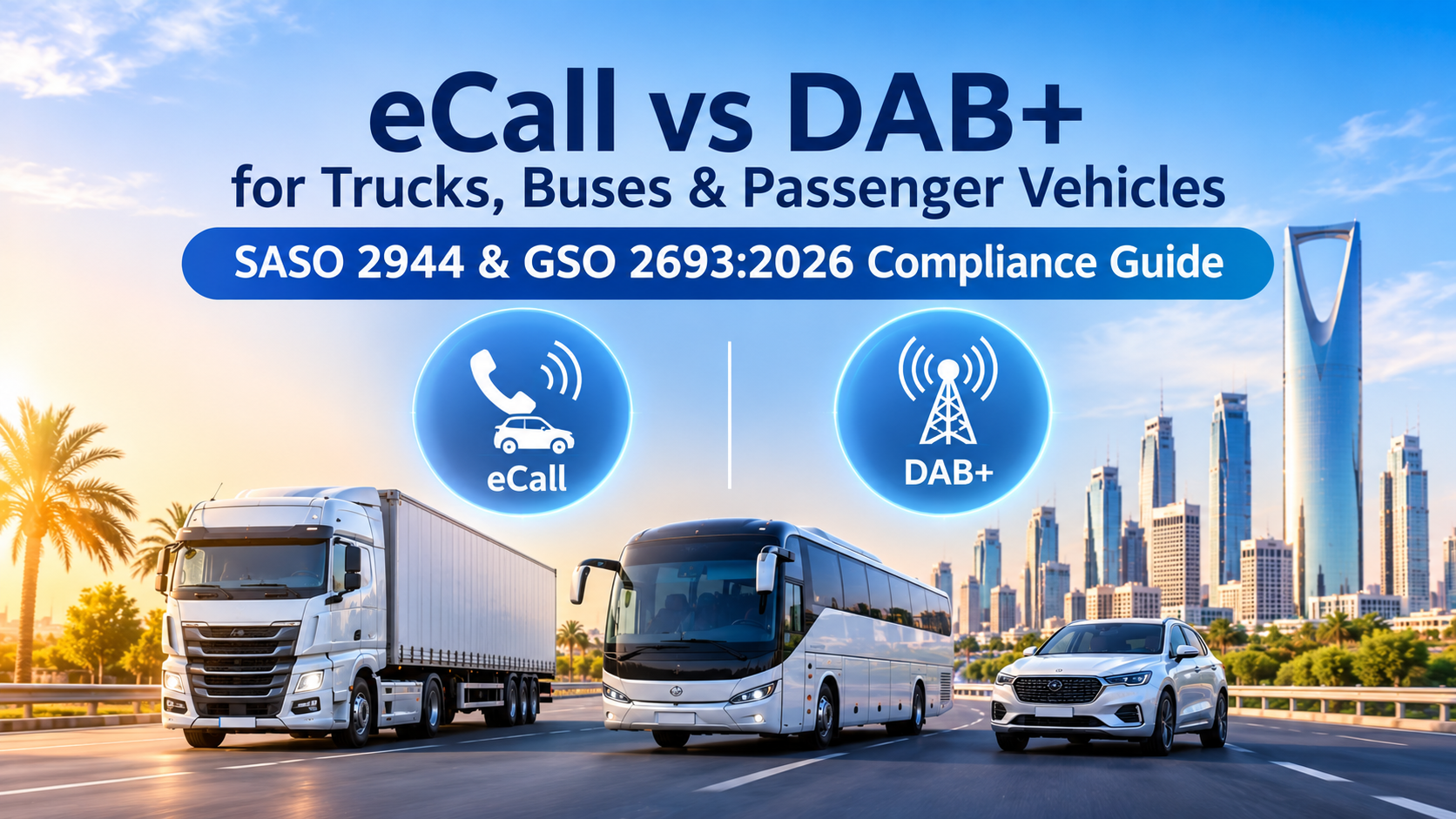
A common mistake in Middle East vehicle compliance is to assume that eCall and DAB+ follow the same vehicle-category rules. They do not.
For a passenger car or light commercial vehicle, Saudi SASO 2944 eCall can be a critical market-access requirement. But for a heavy truck or bus, the same eCall requirement should not simply be copied across.
DAB+ is different again.
With GSO 2693:2026 now published and Saudi Arabia already requiring terrestrial DAB+ capability in vehicle receivers, manufacturers exporting trucks, buses and passenger vehicles to the GCC need to separate two questions:
Is the vehicle itself within the eCall scope?
and
Does the vehicle contain a radio receiver that falls within the applicable DAB+ requirements?
This distinction can prevent both unnecessary testing and compliance gaps.
1. eCall: The 3,500 kg Boundary Matters
Saudi SASO 2944:2023 defines light-duty vehicles as vehicles with a maximum gross weight of 3,500 kg and primarily used for passenger or goods transportation.
The standard requires vehicles within this scope to be equipped with an eCall in-vehicle system. The system must be capable of automatically initiating an emergency call after a severe incident and transmitting the required Minimum Set of Data (MSD). Network-based equipment, including the eCall communication module, must support 4G for type approval.
This creates an important compliance boundary:
Passenger cars / light commercial vehicles ≤3.5 t
→ SASO 2944 eCall scope needs to be assessed.
Heavy trucks >3.5 t
→ Do not automatically apply SASO 2944 simply because the vehicle has telematics or an emergency-call function.
Large buses / coaches
→ Do not automatically treat them as SASO 2944 light-duty vehicles.
The current Saudi notice also states that SASO 2944:2023 will become mandatory for the applicable vehicle models from January 1, 2028, rather than the previously planned January 1, 2027.
Therefore, an OEM planning a 2027–2028 Saudi vehicle launch should first classify the vehicle correctly before starting an eCall certification project.
2. But “Not SASO 2944” Does Not Mean “No eCall Requirements”
This is an important distinction for heavy-vehicle manufacturers.
A truck or bus may still have:
an emergency call function;
a T-box or telematics unit;
a cellular modem;
GNSS;
fleet-management connectivity;
driver emergency communication;
OEM-specific emergency services.
These functions may create separate regulatory, telecom, customer or OEM requirements, even when the vehicle is outside the specific SASO 2944 light-duty scope.
In other words:
SASO 2944 scope ≠ the complete universe of automotive eCall requirements.
For a heavy truck or bus project, the compliance team should therefore ask:
What is the vehicle category?
What is the GVW?
Is an eCall function installed?
Is it an OEM emergency service or regulated eCall?
Which Saudi/GCC telecom requirements apply to the cellular equipment?
Does the target country have additional vehicle-level requirements?
This prevents a common project error: either applying the wrong standard or assuming that no SASO 2944 requirement means no connectivity compliance at all.
3. DAB+ Follows a Different Logic
DAB+ compliance is not based simply on whether the vehicle is a passenger car, truck or bus.
GSO 2693:2026 covers terrestrial AM/FM/T-DAB+ radio receivers, including receivers integrated into vehicle dashboards, aftermarket vehicle receivers and multifunction devices containing radio reception capability.
That means the first question is not:
“Is this a truck?”
It is:
“Does this vehicle or infotainment system contain a terrestrial radio receiver within the scope of the applicable national requirement?”
If yes, the DAB+ compliance assessment needs to be considered.
This is particularly relevant for:
passenger vehicles;
SUVs and MPVs;
light commercial vehicles;
trucks;
buses and coaches;
aftermarket vehicle infotainment;
multifunction infotainment systems.
The regulatory path can differ by country, but the receiver-based scope of GSO 2693:2026 is much broader than the light-vehicle definition used by SASO 2944.
4. Saudi Arabia: DAB+ Is Not Limited to Passenger Cars
Saudi Arabia has required terrestrial DAB+ capability in vehicle receivers since January 1, 2021.
The applicable Saudi reference is SASO 2938:2019, covering AM/FM/T-DAB+ radio receivers.
This creates an important contrast:
eCall
Vehicle-category driven
→ SASO 2944
→ Light-duty vehicles ≤3.5 t
DAB+
Receiver/function driven
→ SASO 2938 in Saudi Arabia
→ DAB+ capable vehicle receiver
So a heavy truck may fall outside the SASO 2944 light-duty eCall scope while still requiring DAB+ compliance if its installed radio receiver falls within the applicable Saudi requirements.
That is why using one “vehicle certification checklist” for every GCC vehicle program can be risky.
5. What Does GSO 2693:2026 Change for Trucks and Buses?
In April 2026, GSO published GSO 2693:2026, updating the GCC technical specification for terrestrial AM/FM/T-DAB+ receivers.
Its scope explicitly includes vehicle-integrated and aftermarket receivers, as well as multifunction products containing radio reception capability.
For manufacturers, this means the compliance question should be evaluated at the infotainment-system level.
For example:
Truck A
No AM/FM/DAB receiver
→ DAB+ receiver requirements may not be relevant to that equipment.
Truck B
Integrated AM/FM/DAB+ infotainment
→ DAB+ compliance needs to be assessed.
Bus C
OEM infotainment with terrestrial radio
→ Review GSO/national DAB+ implementation.
Aftermarket head unit
AM/FM/T-DAB+ receiver
→ GSO 2693:2026 and national implementation are directly relevant.
The exact conformity route still needs to be checked country by country.
6. UAE and Saudi Arabia Should Not Be Treated as Identical
For the UAE, UAE.S 5021:2018 is a mandatory terrestrial AM/FM/T-DAB+ receiver standard. The UAE implementation progressively applied DAB+ to vehicles, reaching 100% from model year 2024.
Saudi Arabia uses SASO 2938:2019, while the GCC framework now also includes GSO 2693:2026.
Therefore, an OEM planning one vehicle platform for:
Saudi Arabia + UAE + Oman + Kuwait + Qatar + Bahrain
should not simply assume:
“One DAB+ report = automatic GCC approval.”
Instead, build a country-by-country evidence matrix:
| Vehicle / System | Saudi Arabia | UAE | Other GCC |
|---|---|---|---|
| AM/FM receiver | Check SASO route | Check UAE route | Check national implementation |
| T-DAB+ receiver | SASO 2938 | UAE.S 5021 | GSO 2693:2026 + national route |
| Integrated infotainment | Review receiver scope | Review receiver scope | Review GSO/national route |
| Aftermarket radio | Review Saudi requirements | Review UAE requirements | Review national requirements |
This approach allows manufacturers to reuse valid evidence without assuming that every country accepts exactly the same certification package.
7. What Should Truck and Bus Manufacturers Do Now?
For a new Middle East vehicle platform, compliance should be planned before the infotainment and telematics configuration is frozen.
Step 1 — Classify the vehicle
Confirm vehicle category, GVW and intended market.
Step 2 — Separate eCall from radio compliance
Create two independent workstreams:
eCall / connectivity
→ Vehicle category
→ SASO 2944 scope
→ CST requirements
→ Cellular module
→ eCall architecture
→ MSD
→ functional validation
DAB+ / radio
→ Radio receiver
→ AM/FM/T-DAB+ capability
→ SASO 2938 / UAE.S 5021 / GSO 2693:2026
→ antenna and receiver performance
→ country-specific evidence
Step 3 — Freeze the hardware configuration
Record:
cellular module;
RF firmware;
DAB+ chipset;
radio software;
antenna configuration;
infotainment hardware;
vehicle integration;
regional software configuration.
Step 4 — Build the evidence reuse matrix
Before repeating tests for every GCC market, compare:
standard edition → test method → limits → product configuration → report scope → national implementation
This is where manufacturers can often reduce unnecessary retesting while maintaining a defensible compliance file.
8. The Strategic Takeaway
For Middle East vehicle exports, “truck,” “bus,” “passenger car” and “light commercial vehicle” are not sufficient compliance classifications.
The more useful approach is to classify each function separately.
eCall → vehicle-category and regulatory scope
DAB+ → radio receiver and national market requirements
Cellular connectivity → telecom/CST requirements
Infotainment → radio + wireless + EMC + vehicle integration
This becomes especially important as vehicles increasingly combine telematics, DAB+, Bluetooth, Wi-Fi, navigation and emergency communication in a single electronic architecture.
How BlueAsia Can Support Your GCC Vehicle Program
BlueAsia Labs supports automotive manufacturers and suppliers with Saudi eCall assessment, CST/RF testing, DAB+ testing, SASO 2938, GSO 2693:2026, UAE.S 5021, EMC, antenna evaluation and vehicle-level connectivity validation.
Our approach is to map the requirements to the actual vehicle category, installed functions and target GCC markets before testing begins.
Planning to export trucks, buses or light commercial vehicles to Saudi Arabia or the GCC?
Start with the compliance boundary—not the test list.
Contact BlueAsia Labs to build your vehicle-specific GCC compliance matrix before certification begins.
 المدونة
Why Buses And Trucks Face Different Connectivity Challenges Than Passenger Cars
اقرأ المقال
 المدونة
The Future Compliance Engineer Will Need to Understand Systems—Not Standards
اقرأ المقال
 المدونة
Trucks and Buses Exported to the Middle East: Do eCall and DAB+ Apply the Same Way?
اقرأ المقال
 المدونة
Your 77 GHz Radar Passed RF Testing. Why Can the Vehicle Still Fail EMC?
اقرأ المقال
 المدونة
Does CE RED Replace EMC Testing? Understanding the Relationship Between Radio and EMC Requir
اقرأ المقال
 المدونة
Does eCall Work Only After a Crash? Understanding Automatic and Manual Trigger Testing
اقرأ المقال

 4000259520